Primary records
Contemporary interviews, catalogs, advertisements, lookbooks, release material, photographs with established provenance and direct statements from responsible participants.
Sources policy
BAAM Boys researches fashion as visual culture and material history. We match the source to the statement, distinguish documentation from interpretation and preserve uncertainty when the available record cannot support a clean conclusion.
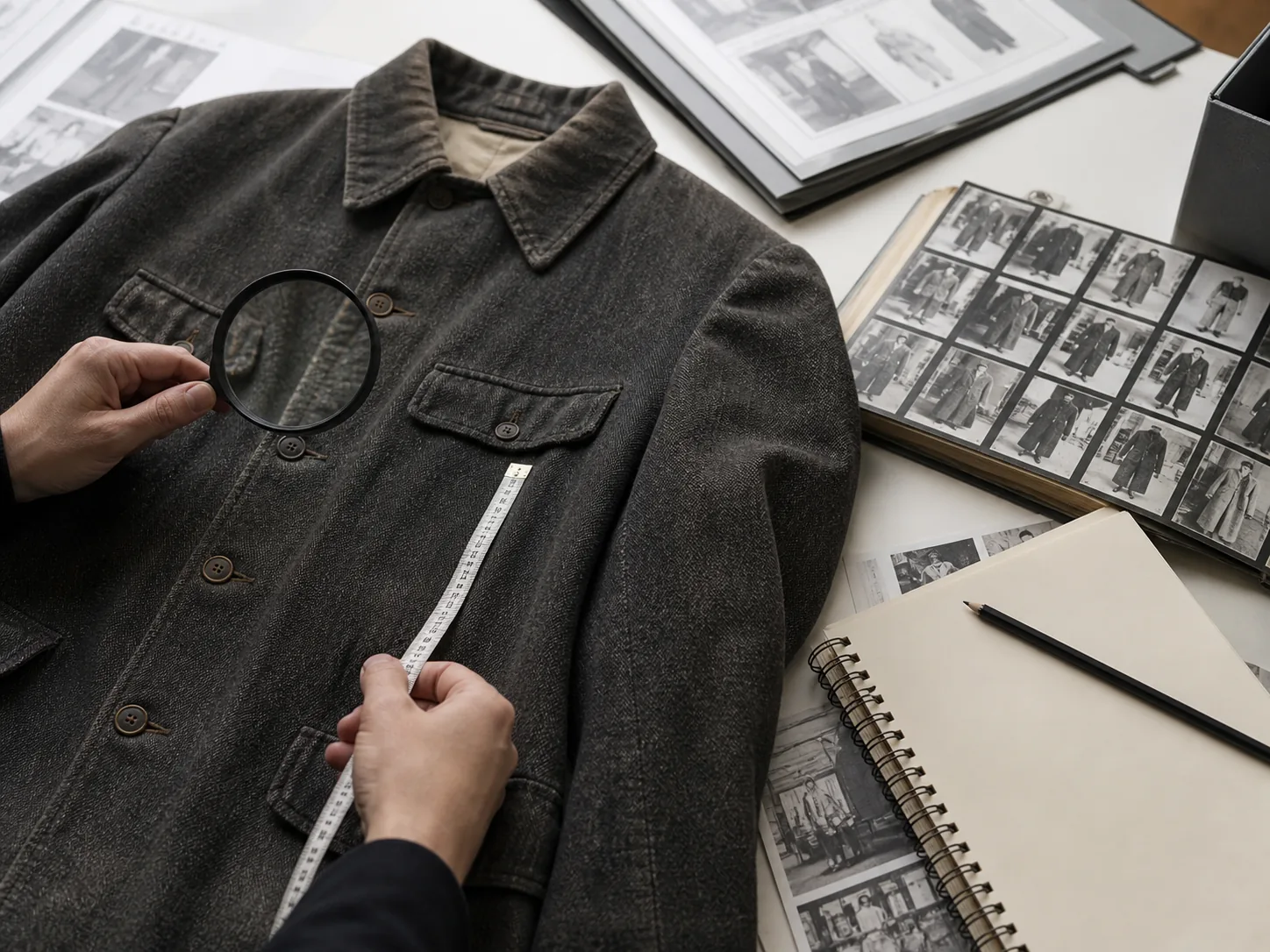
A reader can see that a pictured trouser has a wide leg, but cannot see who designed it, when it was released or how widely it was adopted. BAAM Boys treats observable description, editorial interpretation and externally verifiable fact as different categories. Confusing them creates confident prose with a weak foundation.
Dates, quotations, business relationships, product specifications and named creative credits deserve traceable evidence. Cultural interpretation can draw on several documented examples, but should not turn a handful of celebrity images into a universal statement about Black communities. Practical outfit advice is clearly framed as editorial guidance rather than historical fact.
The standard is proportional. A disputed origin claim requires more corroboration than a recommendation to balance a bulky sneaker with relaxed trousers. A safety-related note about aged footwear receives cautious language and an appropriate professional boundary. Our Editorial Policy explains how these evidence decisions fit the full publishing workflow.
Evidence hierarchy
Contemporary interviews, catalogs, advertisements, lookbooks, release material, photographs with established provenance and direct statements from responsible participants.
Museums, libraries, universities, public collections and established cultural archives that provide curatorial context, dates and rights information.
Credible fashion, music, business and design publications with named reporting, editorial accountability and access to relevant participants or documents.
Books, databases, retailer archives and reputable secondary summaries used to compare details, locate stronger evidence or explain established background.
Visual evidence
Fashion history depends on images, yet images have limits. A stage costume may be deliberately exaggerated for light and camera. An editorial shoot is styled. A catalog presents products for sale. A street photograph records a particular place, person and instant. We identify the context when it materially changes the conclusion.
Multiple visual examples can reveal recurring proportions or styling relationships, but popularity needs broader support. We avoid declaring that “everyone wore” an item because it appears in several famous music videos. Region, class, age, subculture and access all shape clothing practice.
Original illustrative images on BAAM Boys explain garment combinations and visual concepts. They are not passed off as photographs of named performers, historical events or the editorial staff. Captions identify their illustrative function, while historically specific claims should rest on reliable documentation.

Weak and excluded evidence
Search snippets, anonymous aggregation, unsourced timelines and pages that copy one another cannot establish a claim merely because they agree. Ten summaries tracing back to one unsupported statement still amount to one weak origin. We work backward toward the named interview, catalog, photograph, registration, collection record or contemporary report whenever the distinction matters.
Generative tools may help organize questions or expose terms worth investigating, but generated output is not cited as factual authority. It can invent references, merge people and dates or present a plausible interpretation as established history. Every publishable factual statement must survive verification against accessible evidence independent of the generated text.
Retail listings are useful for current product specifications only when the seller is responsible for the item and the record is stable enough to check. Marketplace descriptions, auction titles and reseller claims are interested, changeable evidence. They can reveal a lead or asking price but cannot authenticate an object, prove historical significance or establish a general market value.
Wikipedia and general summaries can provide orientation and vocabulary. They are starting points, not endpoints for contested attribution. We follow their citations, evaluate the underlying material and state only what the stronger record supports.

Links and citations
Links should take readers as close as practical to the supporting record. An institutional collection entry is more useful than a search results screen; an original interview is preferable to a page that merely repeats it. We may link internally for explanation, but an internal article is not independent corroboration.
Linking to a source does not endorse every statement, product or commercial practice on that site. Sources can change, move or disappear. During review, editors check important links and replace dead or weak references when a stable, stronger record is available.
Affiliate tracking must never be disguised as historical evidence. If commercial links are introduced, disclosure appears separately and the editorial conclusion remains independent. Brand material can document what a brand claimed or sold; it cannot by itself prove broad cultural impact.
Corrections and updates
Email hello@baamboys.com with the URL, disputed statement and the strongest primary or institutional material you can provide.
We compare the submission with the original support, assess provenance and decide whether to correct, qualify, expand or retain the statement.
Material corrections and substantial research updates receive a changed modified date. Publication dates are not altered merely to create artificial freshness.
We do not promise confidential-source handling by default. Anyone sharing sensitive information should agree on conditions before sending documents or identifying details.
Source questions
No. Observable description and clearly marked editorial guidance do not require the same citation density as dates, quotations, authorship, specifications or contested historical claims. The evidence burden follows the claim.
An authenticated post can be a primary record of what its author stated, but it may not independently prove a broader historical conclusion. Context, date, authorship and corroboration still matter.
Brand records can document releases, campaigns and the brand's account of its history. They are interested sources, so broader cultural or disputed claims should be compared with independent evidence.
Personal memories can reveal local detail and useful research leads. They are attributed and contextualized, not automatically generalized to an era or entire community.
The article describes the material disagreement, attributes the competing accounts and avoids false certainty until stronger evidence resolves it.