Hip-Hop Style · 1990—1999
90s Hip-Hop Fashion Was a Moving Cultural Map
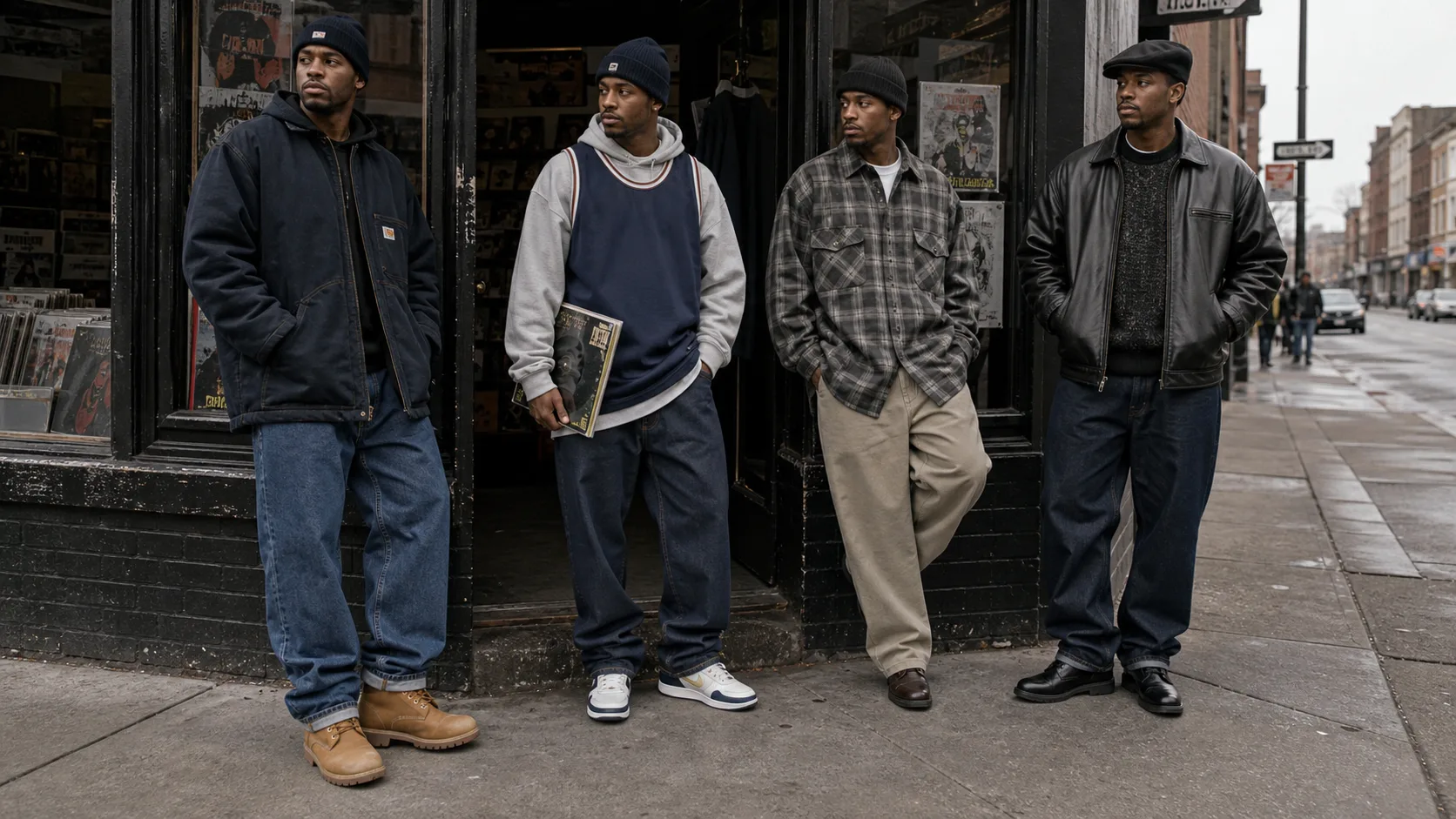
Baggy denim, workwear, sports jerseys, leather, boots and basketball sneakers made 1990s hip-hop style immediately legible. The deeper story is how artists, stylists and local communities changed those pieces across regions and throughout the decade.
In one paragraph
What was 90s hip-hop fashion?
1990s hip-hop fashion paired increasingly relaxed silhouettes with clothing drawn from work, sport, campuses, neighborhood retail and luxury aspiration. Loose jeans, heavyweight tees, hoodies, utility jackets, jerseys, varsity layers, leather, caps, work boots and basketball sneakers were prominent. The look was never universal: East Coast layering, West Coast ease and varied Southern approaches created different visual languages, while the decade moved from colorful early-90s coordination toward heavier mid-90s workwear and longer late-90s proportions.
01
The silhouette changed while the decade was happening
Early-1990s hip-hop imagery still carried energy from the previous decade. Coordinated sportswear, patterned jackets, leather, caps and bright contrast could sit beside relaxed tailoring and denim. Clothes were becoming roomier, but the extremely long layers associated with the next era had not yet taken over.
By the middle of the decade, visual weight increased. Denim widened, hoodies became substantial and work jackets or utility layers gave outfits a grounded surface. Boots and padded basketball shoes balanced hems that covered more of the foot. Muted earth tones, black and deep denim made construction and scale more visible.
Late-1990s style stretched further. Tees and jerseys grew longer, jeans widened and technical sportswear became more pronounced. Luxury references also became increasingly visible. That combination points toward the early 2000s, when camera-ready scale, coordinated sets and aspirational dressing expanded again.
Color, matching sportswear, leather, patterned layers and relaxed denim.
Heavy workwear, hoodies, wide jeans, boots, varsity layers and jerseys.
Longer tops, wider hems, technical footwear and more visible luxury.
Period labels remain approximate. Clothing stayed in wardrobes for years, and media did not reach every community at the same speed. The broader 90s Black fashion guide places music imagery beside work, social, campus and formal wardrobes.
02
Ten pieces built the visual vocabulary
Room through the thigh and hem changed the body's outline and allowed fabric to stack over substantial footwear.
A long, clean base established width under flannel, jersey, jacket or open shirt.
Warmth and volume made it useful alone or beneath work and varsity jackets.
Dense fabric and practical pockets connected music imagery to everyday utility.
Team, player and city associations supplied identity beyond decoration.
Collegiate and athletic references gave the shoulder structure and visible contrast.
Leather moved between rugged street image, adult polish and luxury.
A firm sole and heavy upper visually supported loose jeans and cold-weather layers.
Technical panels, padding and cultural association connected sport with music.
Fitted caps, knit caps and bucket hats completed the head-to-toe outline.
The list is evidence of range, not a shopping prescription. A coherent outfit might use only three or four elements. For practical combinations, see 90s hip-hop outfit ideas for men.
03
Region changed the rhythm of familiar clothes
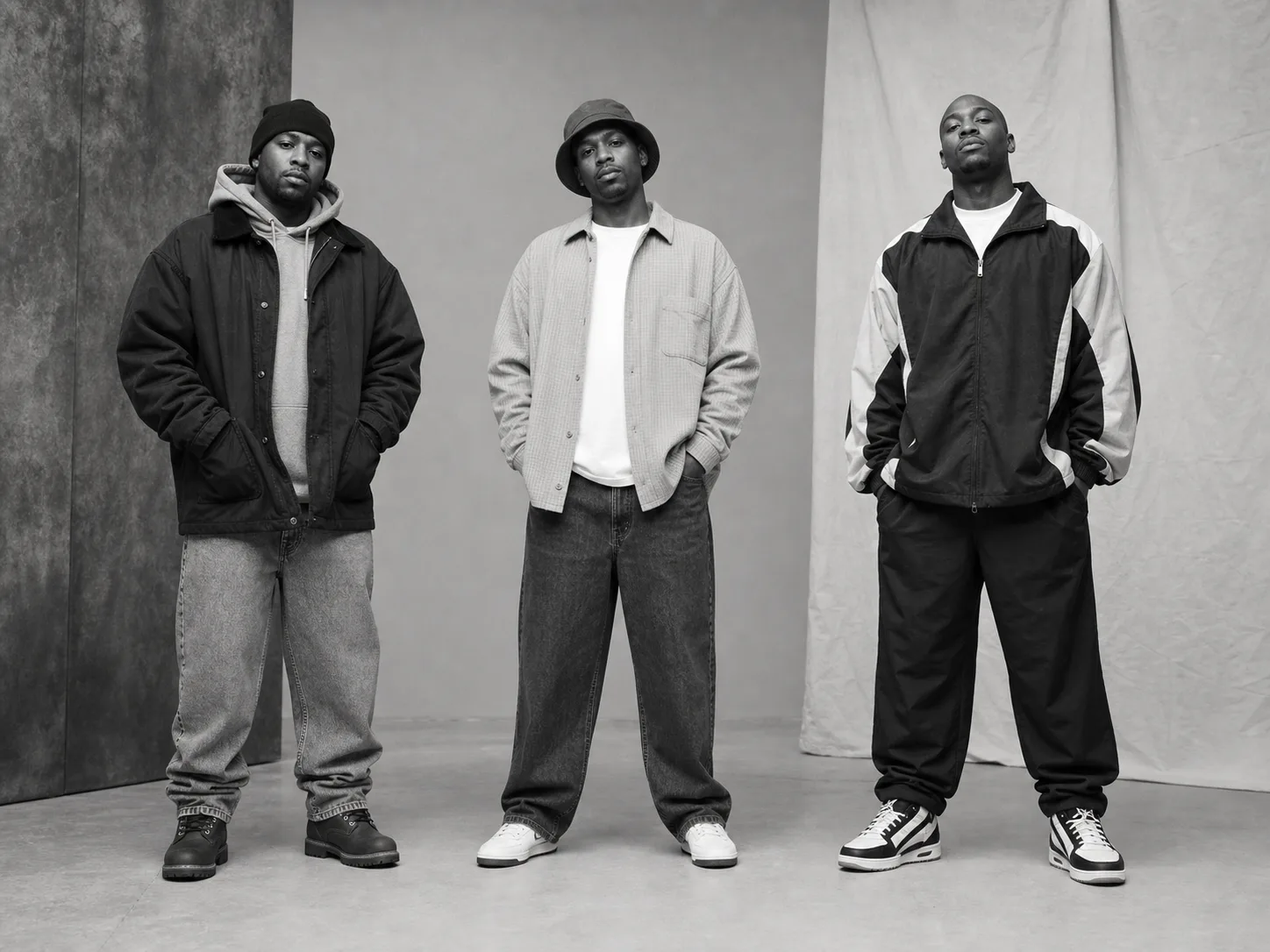
In the Northeast, colder seasons encouraged dense layering, knit caps, hoodies, work jackets and sturdy boots. The shoe often felt anchored and the outer layer carried much of the outfit's identity. New York visibility was powerful, but it cannot stand in for every East Coast city or scene.
West Coast imagery frequently used relaxed overshirts, plain tees, straight or loose trousers and cleaner low footwear. The line could feel easier and less stacked, shaped by climate, car culture and local traditions. That description still contains enormous variation.
Southern scenes were not one late-arriving copy. Cities developed distinct relationships with sportswear, vivid coordination, tailoring, jewelry and eventually oversized proportions. Touring, television and migration moved ideas between regions, so influence rarely followed a single direction.
04
The famous outfit was often collaborative work
A music video outfit may look spontaneous while being carefully built for lighting, movement and narrative. The artist supplied character and preference; a stylist found and coordinated garments; designers and retailers supplied form; directors and photographers determined how scale appeared on camera. Local style communities supplied the language long before a national audience learned to name it.
That distinction matters when discussing influence. A performer can popularize a silhouette without inventing every garment inside it. A brand can benefit from music visibility without being the origin of a community practice. Reliable fashion history names documented contributors and leaves uncertainty visible when credits are unavailable.
Stage and video clothing also exaggerate effectively. Reflective jewelry, large contrast and oversized layers remain legible at distance. Everyday photographs often reveal quieter versions: a clean knit, relaxed jean or practical jacket. Both are part of hip-hop fashion, but they answer different visual needs.
Hip-hop did not turn one uniform into a worldwide trend. It turned the act of coordination, scale and self-definition into a global fashion force.
05
Shoes and accessories controlled the finish
Work boots created a dense base and made sense with cold-weather layers. Basketball sneakers carried sport, technology and player association; their padded construction balanced wide denim. Clean low-tops offered a quieter choice for polos, leather or relaxed overshirts. Our Sneakers archive explains why sole volume and trouser opening should be considered together.
Jewelry communicated success, affiliation and personal identity, but scale varied greatly. A chain, ring or watch could be enough. Hats altered the outline and sometimes expressed team or city association. Belts and eyewear added smaller focal points. Accessories worked best when they reinforced an already coherent silhouette rather than substitute for one.
06
Wear the proportion, not the costume
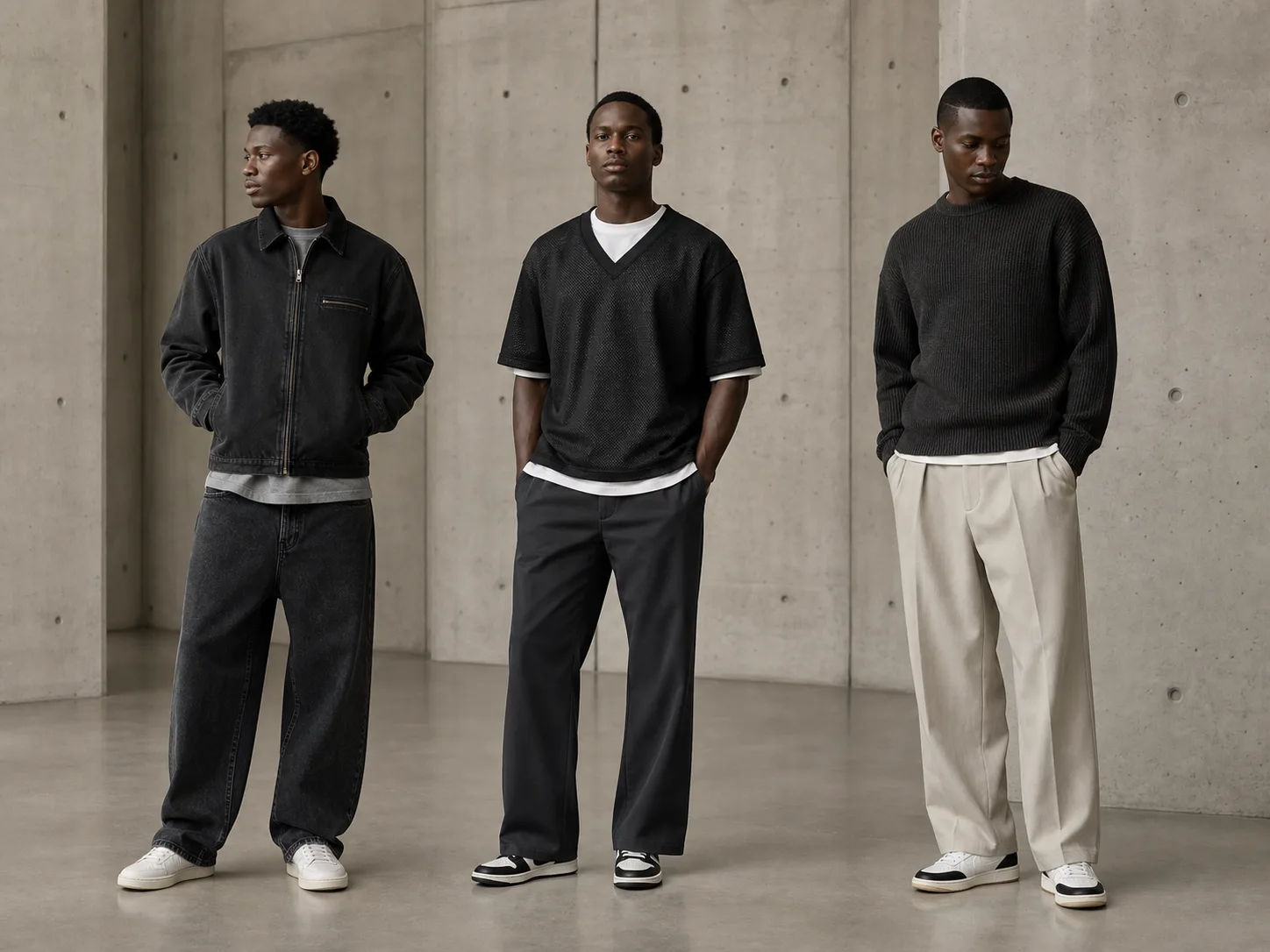
A modern interpretation begins with controlled room. Choose relaxed jeans with a usable rise and hem, then let a compact work jacket create contrast. Alternatively, place a roomy jersey over a heavyweight tee and use a straighter trouser so the outfit does not expand everywhere.
For a polished direction, combine a fine knit with a wide pleated trouser and understated retro sneaker. The connection to the 1990s comes from space and weight rather than a collection of obvious symbols. Black, charcoal, cream and faded denim make those relationships easy to read.
One historical reference is usually enough. Avoid combining baggy jeans, giant jersey, multiple chains, bucket hat and oversized jacket simply because each appeared during the era. Clothing should suit your body, climate and actual setting. The Men's Style desk provides a broader fit method.
07
How to read a 90s reference accurately
- Start with date. Separate early, middle and late decade before assigning a trend.
- Identify setting. A stage, video, family snapshot and street photograph provide different evidence.
- Read silhouette. Note shoulder, shirt length, rise, leg width, hem and shoe volume.
- Check region carefully. Use location as context, not a stereotype or proof of ownership.
- Trace credits. Look for stylist, designer, photographer and publication information.
- Distinguish observation from claim. Visible clothing can be described directly; origin stories require sources.
This method also helps shoppers avoid mislabeled vintage products. A reseller's decade description is a lead, not proof. Construction, label history and provenance matter more than keyword repetition.
Evidence trail
Sources & Further Reading
These references support the historical, cultural or care-related claims in the guide. Outfit combinations and fit recommendations are BAAM Boys editorial judgment unless specifically attributed.
- The Museum at FIT — Fresh, Fly, and Fabulous: Fifty Years of Hip Hop Style
Curatorial overview connecting hip-hop clothing to community, customization, aspiration and fashion-industry influence.
- Smithsonian NMAAHC — Five Things to See: The Fashion of Hip-Hop
Collection-based examples of garments, jewelry, photographs and sneakers used to document hip-hop style.
- The Metropolitan Museum of Art — Superfine: Tailoring Black Style
Institutional context for Black dress, identity, tailoring and self-presentation across time.
Common questions
90s hip-hop fashion FAQ
What clothes defined 90s hip-hop fashion?
Loose denim, heavyweight tees, hoodies, work and varsity jackets, sports jerseys, leather, work boots, basketball sneakers and hats were prominent. Combinations changed by phase, region, artist and setting.
Why was 90s hip-hop clothing so baggy?
Relaxed clothing drew from several sources, including sportswear, workwear and local street style. Hip-hop artists made roomy proportions highly visible, while scale also helped performers create presence on camera and stage.
Was all 90s hip-hop fashion oversized?
No. Prep, fitted knitwear, leather, relaxed tailoring and cleaner straight denim remained visible. Even baggy outfits varied considerably in shoulder width, shirt length and trouser shape.
What shoes match a 90s hip-hop outfit?
Retro basketball sneakers, sturdy work boots and clean low-tops fit different directions. Match shoe weight to trouser width, then consider climate and whether the outfit leans athletic, rugged or polished.
How can men wear 90s hip-hop style today?
Use one controlled period proportion: relaxed jeans with a compact jacket, a roomy jersey with straight trousers, or wide pleated trousers with a fine knit. Keep logos and accessories restrained.