Image systems, not costumes
80s Rapper Fashion: How Artists Built a Recognizable Look
The most memorable 1980s rapper outfits worked as complete identity systems. Coordinated leather, athletic uniforms, brimmed hats, clean sneakers, tailoring, jewelry and grooming were edited for group unity, movement, photography and stage distance. One famous item rarely carried the image alone.
Direct answer
What made an 80s rapper outfit memorable?
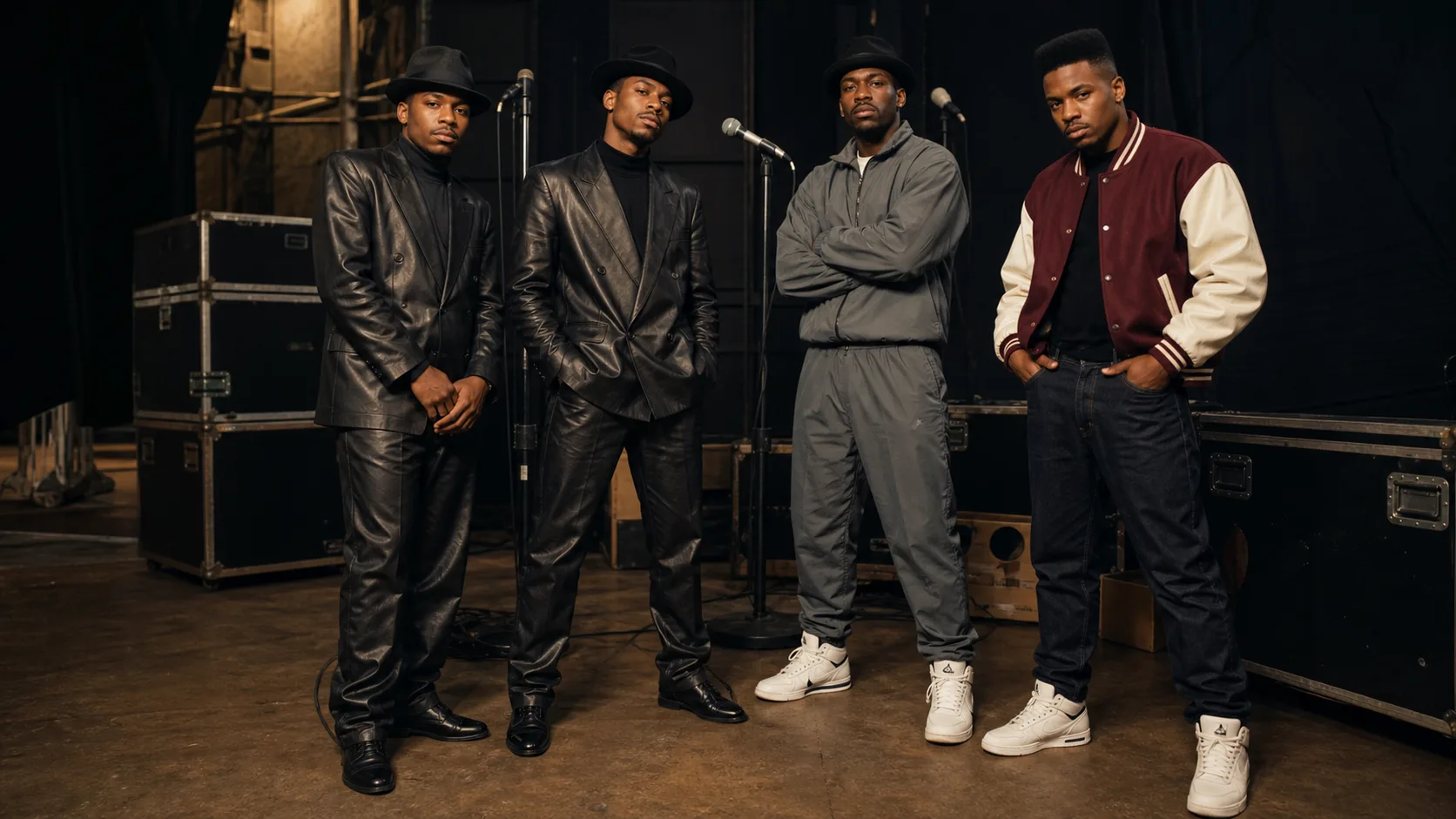
A strong rapper outfit repeated a small number of decisions: one dominant material, a clear silhouette, consistent footwear, disciplined accessories and grooming that could be recognized in a photograph or across a stage. Leather projected control, coordinated tracksuits emphasized movement, tailoring introduced authority and a signature hat or chain made the outline identifiable. The outfit served the artist's character rather than following one universal hip-hop uniform.
Leather authority
Matched black surfaces, controlled shine and polished footwear formed a camera-ready uniform.
Athletic motion
Track jackets, straight pants and high-tops supported choreography and group coordination.
Tailored command
Structured jackets, pleated trousers and dark knits connected rap image to broader menswear power.
Street collegiate
Varsity outerwear, denim and court shoes gave team language an everyday edge.
01 / Persona
Clothing made sound visible before the first verse
A promotional photograph had to introduce an artist without movement or audio. The wardrobe therefore carried information quickly. Dark leather could make a group appear disciplined and formidable. An athletic set suggested energy and physical precision. A tailored coat or brimmed hat borrowed authority from established menswear. A varsity jacket connected an artist to youth, team identity and the neighborhood.
None of these meanings was automatic. Pose, lighting, grooming and repetition helped stabilize the message. Wearing a hat once created an outfit; returning to the same outline across covers, television and performance built a signature. The useful lesson for modern dressing is consistency. Personal style becomes legible when several choices recur, not when every outfit introduces a new costume.
The broader 80s Hip-Hop Fashion guide follows the culture-wide vocabulary. This analysis narrows the lens to image construction around performers and groups.
02 / The archetypes
Four routes to visual authority
Matching color, material or outerwear made several bodies read as one unit. Small differences in hats or jewelry preserved individuality.
A clean track uniform communicated control in motion. Shoes and pant length had to survive rehearsal as well as photography.
Tailoring, knitwear and refined leather connected lyrical command to mature menswear codes.
Varsity, denim and everyday footwear preserved proximity to local life while becoming sharper for the camera.
These are analytical categories, not boxes that every artist occupied. Performers could shift between them or combine two. A tailored trouser under athletic outerwear, for example, could hold polish and movement together. The key is identifying the dominant message rather than cataloging every garment.
03 / Behind the image
A famous look was usually edited
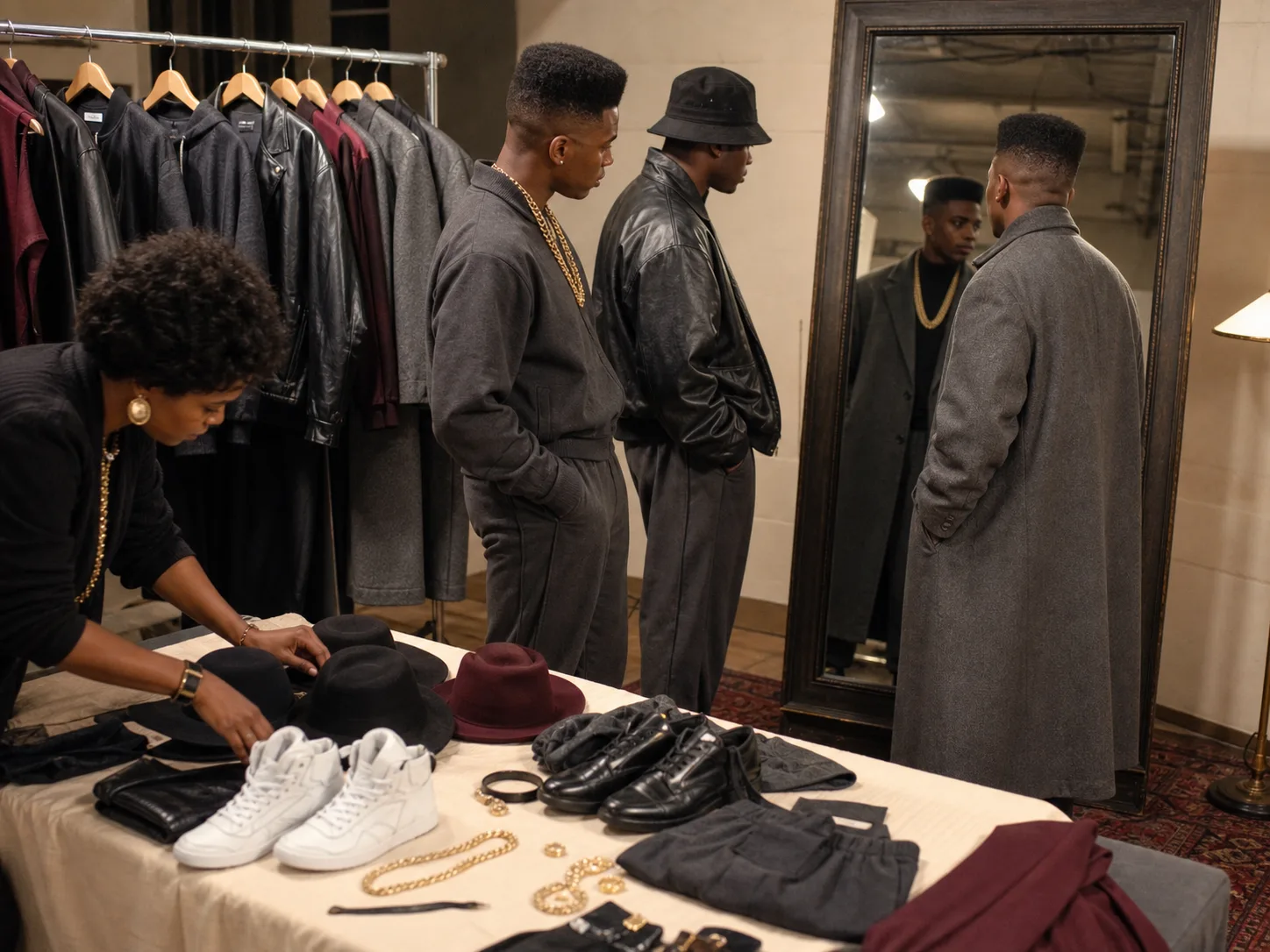
Even when artists supplied their own taste and community references, a cover, video or television appearance required decisions. Garments had to fit the frame, survive lights and allow performance. A stylist might repeat one color across a group, remove a distracting accessory or shorten a trouser so the shoe remained visible. Photographers then selected angles that strengthened the silhouette.
This matters when using celebrity imagery as historical evidence. A publicity photograph records a constructed persona, not an average Tuesday. It can prove that a particular visual idea circulated at a certain time, but it cannot prove that everyone dressed that way. Compare the image with interviews, live footage and street documentation before extending the claim.
The fitting-room hierarchy
- Test movement and microphone handling.
- Confirm each member reads as part of the same visual world.
- Check reflective leather and jewelry under actual light.
- Photograph from stage distance, then remove details that disappear or compete.
04 / Group identity
Uniform did not have to mean identical
A rap group could coordinate through one shared element rather than exact duplication. All members might wear black leather while choosing different jacket lengths. A gray athletic base could repeat across the group while hats or undershirts carried individual accents. Consistent footwear could hold together otherwise varied tops. This balance allowed the audience to recognize a unit and still distinguish personalities.
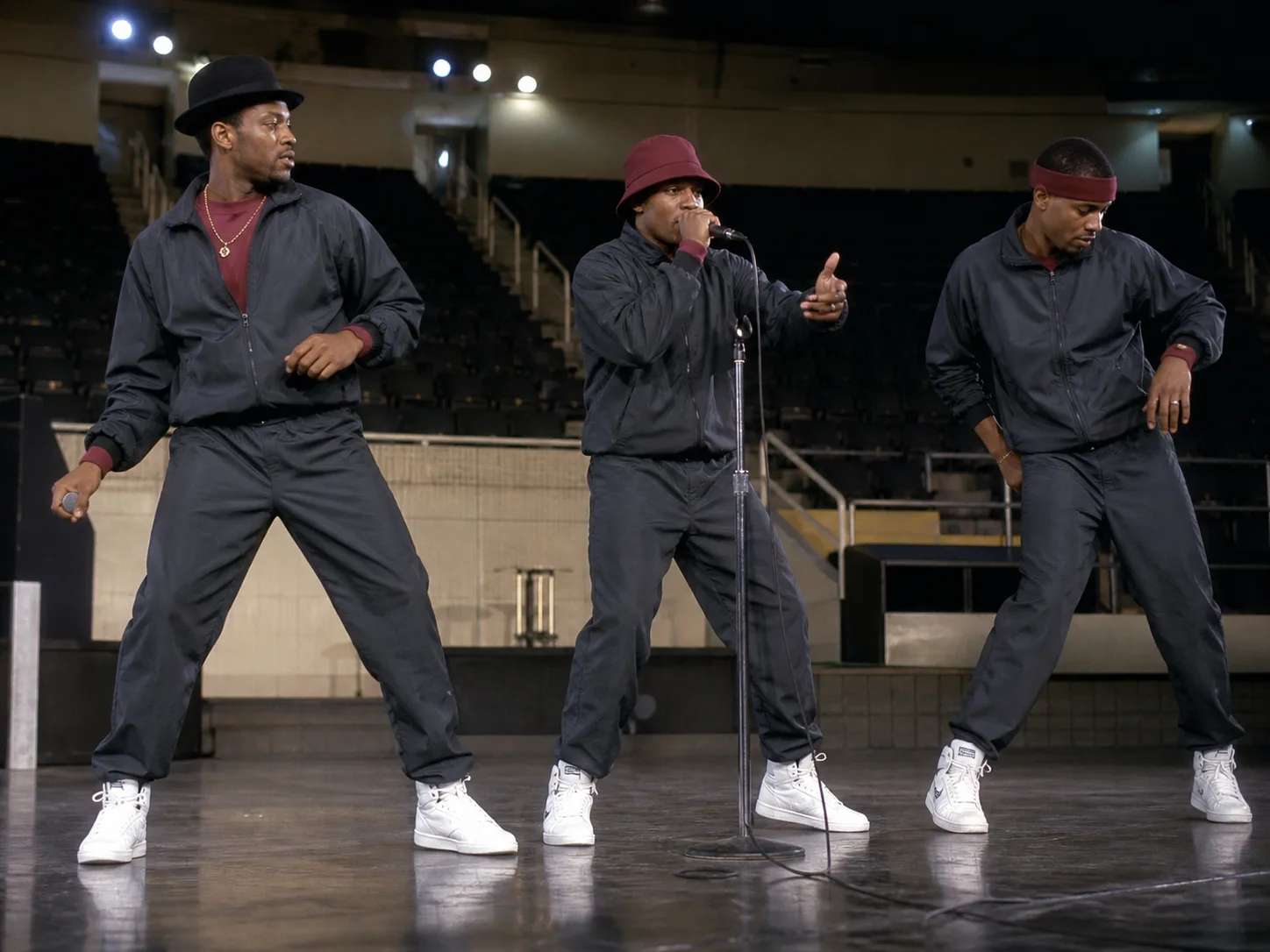
The strongest shared systems also worked in motion. Loose but controlled track pants supported footwork. Short jackets kept the torso legible. High-top sneakers protected and visually anchored the ankle. During a rehearsal, the group could see whether one trouser caught under a shoe or one reflective surface stole the entire frame.
Select the shared color, material or silhouette.
Give each performer one recurring personal detail.
Review the group from camera and audience distance.
05 / Performance
Clothing had to survive breath, heat and movement
Stage dressing is a practical discipline. Leather looks decisive but can trap heat. Heavy jewelry moves against the body. A hat must remain secure. Athletic nylon offers range but changes under strong lighting. Footwear must grip and absorb impact. An artist may therefore use a visually similar but lighter garment for performance than for portraiture.
The full outfit also needs a readable lower half. White or light sneakers against dark track pants make footwork visible. A straight hem creates motion without tangling. A repeated burgundy base layer can flash during movement while keeping the group's main gray system intact. What looks simple from the audience may be the result of careful rehearsal.
The Sneakers archive explores footwear construction and history. For modern styling, never perform in aged vintage sneakers before checking sole integrity; foam and adhesives can fail regardless of cosmetic condition.
06 / Modern translation
Borrow the method, not an artist's identity
Celebrity style can provide proportion and coordination lessons without becoming impersonation. Choose the system that answers your setting. A tonal track outfit works for casual movement. A waist-length leather jacket over pleated trousers suits dinner or a creative event. A varsity jacket with straight denim handles everyday wear. Avoid replica stage jewelry, fake logos or head-to-toe copying associated with a specific person.
Repeat one material
Use leather only at the jacket and shoe, then keep the inner column matte.
Coordinate two tones
Build charcoal clothing around one cream or muted burgundy accent.
Choose a signature
A hat, eyewear shape or footwear category can recur without duplicating an icon.
Edit at distance
Photograph the full silhouette and remove any detail that competes with the face.
For a broader daily wardrobe, 80s Black Men's Fashion covers tailoring, knitwear and social settings beyond rap. For the following decade, 90s Rapper Outfits shows how longer and wider proportions changed artist image.
07 / Source discipline
Do not turn memory into a universal fact
Iconic images dominate search results because they are memorable and repeatedly reproduced. That visibility can distort the historical record. Date the image, identify whether it is a cover, video, concert or candid scene, and separate what is visible from an interpretation of why it was chosen. A branded garment may be documented; a claim that it transformed an entire community requires stronger evidence.
Our generated editorial images are labeled as reconstructions. They help explain group coordination and silhouette but are not archival photographs. The BAAM Boys Editorial Policy explains how visual illustration, historical evidence and interpretation remain distinct.
Evidence trail
Sources & Further Reading
These references support the historical, cultural or care-related claims in the guide. Outfit combinations and fit recommendations are BAAM Boys editorial judgment unless specifically attributed.
- The Museum at FIT — Fresh, Fly, and Fabulous: Fifty Years of Hip Hop Style
Curatorial overview connecting hip-hop clothing to community, customization, aspiration and fashion-industry influence.
- Smithsonian NMAAHC — Five Things to See: The Fashion of Hip-Hop
Collection-based examples of garments, jewelry, photographs and sneakers used to document hip-hop style.
- The Metropolitan Museum of Art — Superfine: Tailoring Black Style
Institutional context for Black dress, identity, tailoring and self-presentation across time.