Culture in motion
80s Hip-Hop Fashion: From Community Style to a Global Image
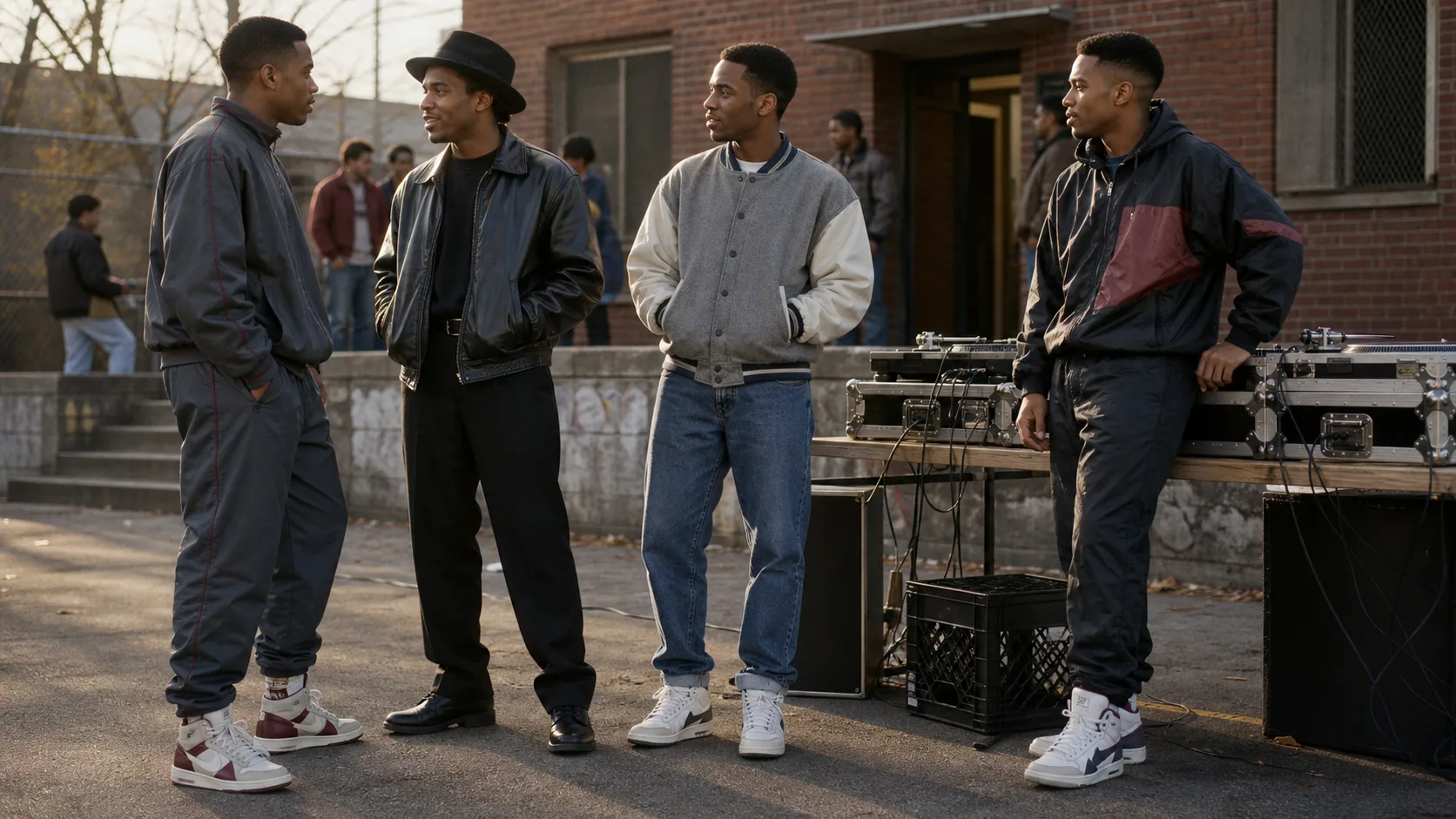
1980s hip-hop fashion used coordinated tracksuits, leather outerwear, brimmed hats, sneakers, varsity jackets, denim, jewelry and sharp grooming to turn everyday garments into intentional public style. The look changed across the decade and from crew to crew; cleanliness, coordination and identity mattered more than any fixed shopping list.
Quick look
What defined 1980s hip-hop clothing?
Hip-hop style in the 1980s was defined by deliberate coordination. Athletic sets created a unified line; leather supplied authority; hats and eyewear shaped a recognizable identity; sneakers connected movement, sport and street presentation; jewelry communicated aspiration and stage presence. Early-decade party dressing did not look identical to late-decade rap imagery, and highly styled performers never represented every neighborhood wardrobe.
| Phase | Visible direction | Key pieces | What changed |
|---|---|---|---|
| Early 1980s | Dance-floor coordination | Athletic tops, leather, hats, clean sneakers | Street and party clothing gained crew identity |
| Mid-1980s | Sharper group image | Tracksuits, outerwear, bolder footwear, jewelry | Video and photography strengthened visual codes |
| Late 1980s | More competing personas | Dark leather, technical sportswear, tailored details | Artists used clothing to separate sound and character |
01 / Origin logic
Hip-hop did not invent every garment; it changed the arrangement
Tracksuits, sneakers, leather jackets and brimmed hats existed before hip-hop. The cultural innovation was in how familiar items were cleaned, matched, customized, repeated across a crew and carried in public. A coordinated athletic set could frame synchronized movement. A particular hat angle or jacket length could become part of an artist's silhouette. Shoelaces, jewelry and grooming supplied close-range precision after the larger outline was established.
This distinction keeps the history grounded. A product list cannot explain why two people wearing similar objects communicate different identities. Fit, condition, gesture, music, geography and audience all contribute. The Hip-Hop Style hub treats the culture as a network of regional and creative decisions, not a single dress code.
The wider 80s Black Men's Fashion guide also matters here. Hip-hop existed inside a much larger Black wardrobe of tailoring, collegiate knitwear, workplace clothing, church dressing and neighborhood casual style. Artists borrowed from and reacted to that environment rather than operating outside it.
02 / Four visual systems
The era worked through recognizable combinations
A matching jacket and pant created a complete graphic line that moved well onstage and outdoors.
Bombers, car coats and coordinated leather could read polished, hard or theatrical according to cut.
Hats, eyewear, hair and footwear established a repeatable silhouette for individuals and crews.
Athletic clothing could meet jewelry, polished shoes or tailored elements without losing street context.
These systems overlapped, yet they should not be collapsed. A dance-oriented athletic outfit solves movement differently from a dark leather stage uniform. A varsity jacket communicates school and team language; a brimmed hat may introduce an older line of menswear elegance. Good analysis names what each component does instead of labeling everything “old school.”
03 / Image making
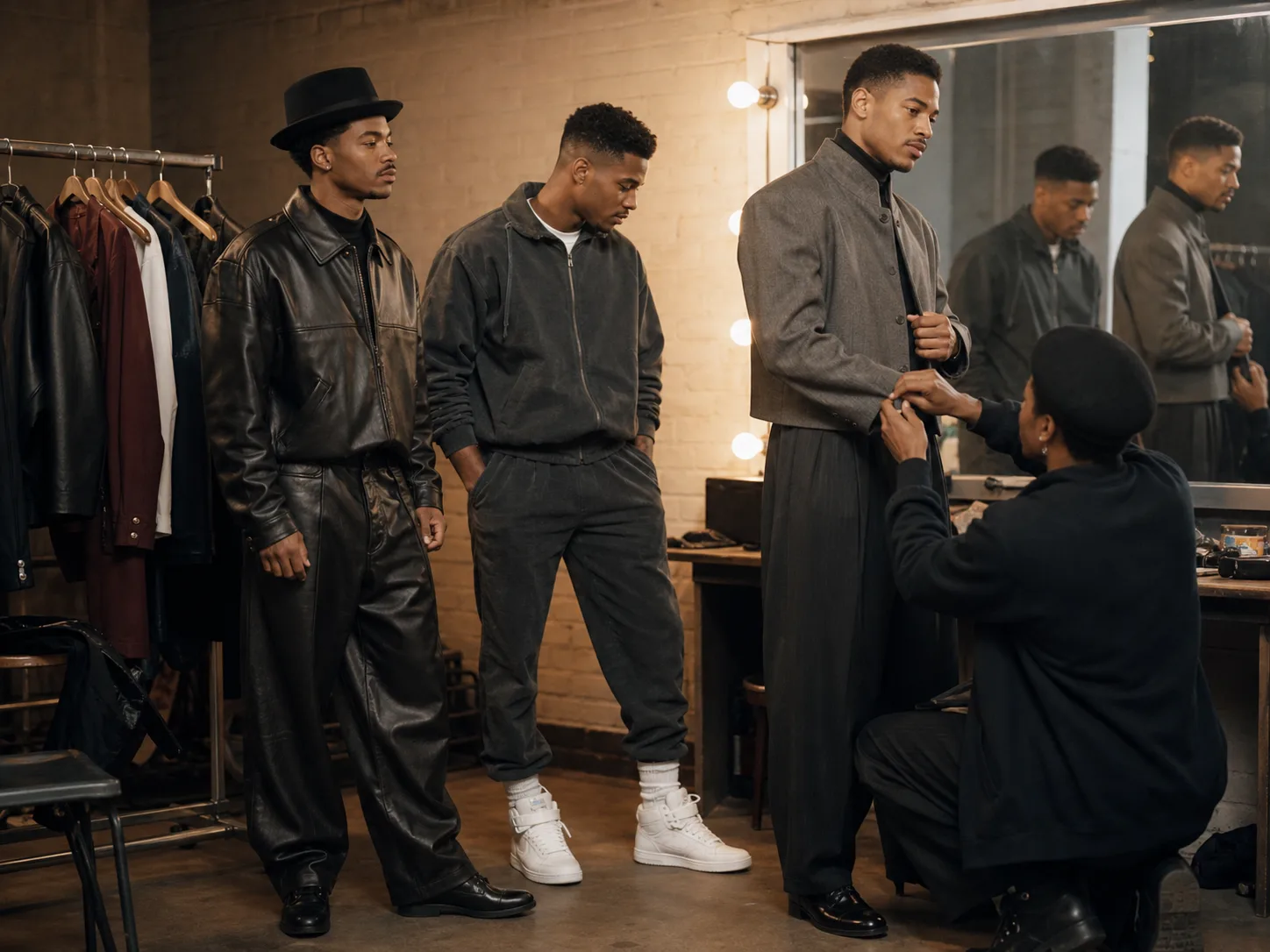
Stage, video and portrait clothing were constructed
An album portrait compresses identity into a single frame. A video adds lighting, choreography and repeated viewing. A live show demands movement and distance. Stylists, artists, photographers and crews therefore made choices that could read instantly: a continuous leather surface, a hat with a strong brim, a matched set, a contrasting sneaker or a chain that caught stage light.
When people recreate these images today, they often copy the loudest object and miss the editing. The outfit may have been selected as a uniform across several performers, altered for movement or designed to separate an artist from competitors. Treat the image as a production decision. Ask what the clothing needed to communicate, then decide whether that function belongs in a present-day outfit.
The 80s Rapper Fashion analysis focuses on performer archetypes. Here the useful conclusion is simpler: stage imagery is cultural evidence, but it should be compared with street photographs, interviews and ordinary social scenes before becoming a claim about everyone.
04 / Place and change
New York was central, not universal
Accounts of 1980s hip-hop naturally return to New York, where the culture's foundational practices developed and where weather encouraged substantial jackets, leather and layered sportswear. Even within the city, borough, crew, age and venue produced variation. As rap records, touring, radio and video traveled, other communities interpreted the visual vocabulary through local climate and existing dress.
That process was not one-way copying. Artists outside the birthplace brought different relationships to color, tailoring, cars, sports and regional brands. A national image began to form, but local style continued to resist a uniform. When a source labels one outfit “the” 1980s look, check its year and place. Early party photographs, mid-decade television and late-decade promotional portraits can point in different directions while remaining accurate.
Useful for everyday combinations, though one frame has limited scope.
Shows movement and visibility, often with deliberate exaggeration.
Reveals image strategy more than average daily clothing.
Can explain intent, access and memory when dated carefully.
05 / Details
Accessories worked as punctuation
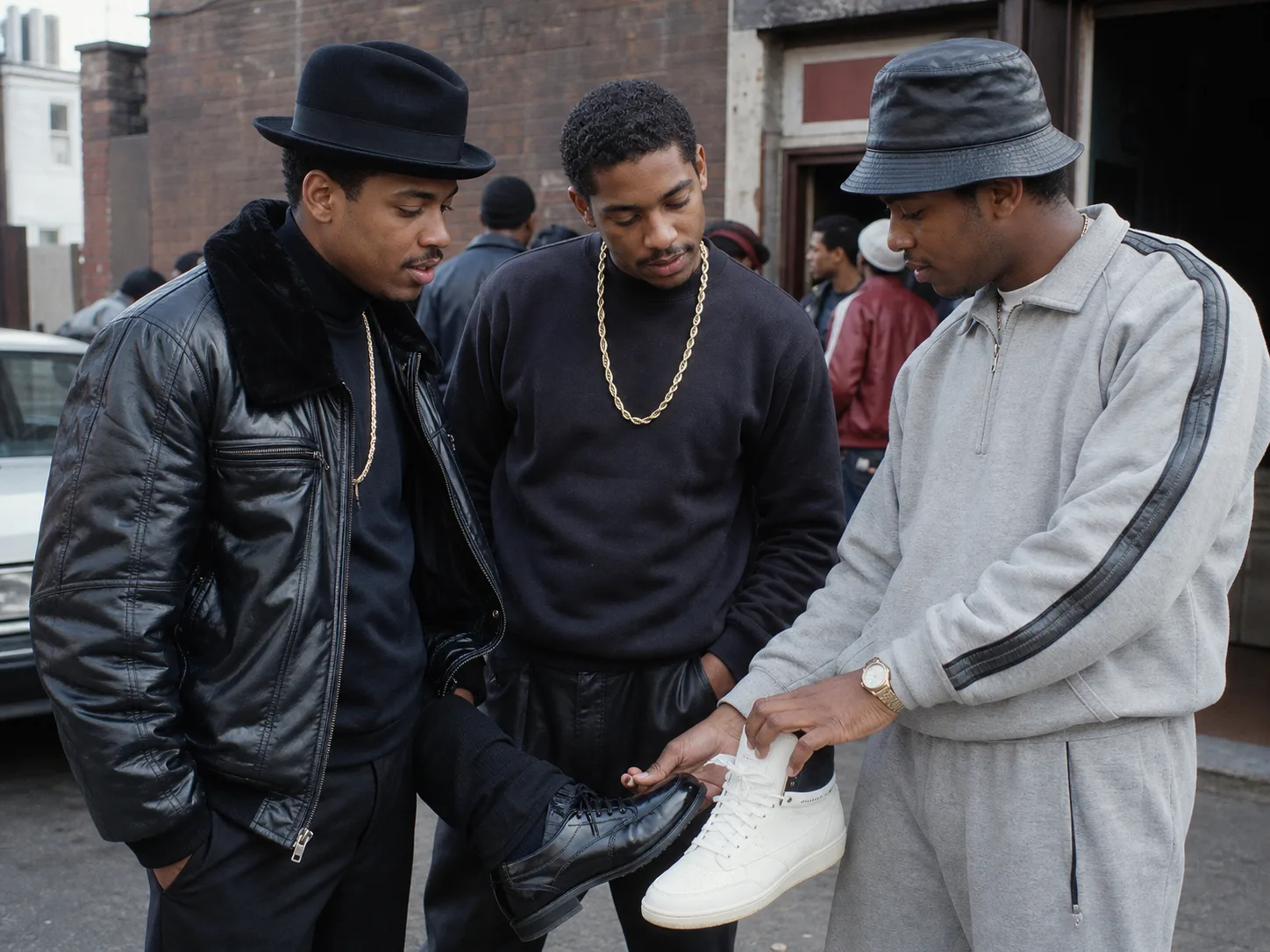
Jewelry, hats, eyewear and watches could define a persona, but their strength depended on a quiet base. A rope-style chain against a plain dark crewneck reads clearly because the surface behind it is simple. A brimmed hat creates a silhouette before its material is noticed. A watch reinforces polish without competing with the jacket.
Footwear completed the lower edge. High-top court shoes supported athletic pants and straight denim; polished black shoes could sharpen leather or tailored clothing. Shoe condition was visible cultural labor. Clean laces and maintained uppers often mattered more than rarity. The relationship between hem and shoe also stayed crucial: a straight track pant meets a high-top differently from a narrow modern jogger.
For more footwear context, visit the Sneakers desk. For a decade comparison, 80s vs 90s Hip-Hop Fashion explains how later volume changed the role of accessories and shoes.
06 / Wear it now
Build from one system, then stop
Tonal track line
Deep-gray track jacket, matching straight pant, plain cream tee and clean high-top court shoe.
Leather and polish
Waist-length black leather jacket, dark mock neck, pleated trouser, polished shoe and one slim chain.
Varsity balance
Gray varsity jacket, straight medium-wash denim and neutral sneaker, with no extra theme pieces.
Hat-led tailoring
Restrained brimmed hat, short structured jacket, dark trouser and clean leather shoe.
The modern test is coherence. If removing one accessory makes the reference disappear, the outfit may be relying on a symbol instead of proportion. If the trousers, jacket and shoe already form a strong line, the hat or jewelry can remain optional. Avoid replica logos and combinations that turn Black cultural history into a party costume.
Vintage athletic wear needs practical inspection. Elastic can fail, nylon coatings may separate and old footwear may be unsafe even when it looks unworn. Request measurements, examine stress points and consider a modern garment with the correct shape when the original cannot support regular use.
07 / Reading responsibly
Separate influence from ownership claims
Hip-hop helped carry numerous styles into global view, yet credible writing should distinguish amplification from invention. Athletic companies, formal menswear traditions, street customization and Black community aesthetics all met inside the culture. The result was transformative precisely because it reorganized existing materials through sound, movement, competition and identity.
A useful source record includes dates, locations and image type. It avoids treating one celebrity as a census. It also acknowledges that generated editorial illustrations—such as the images used here—clarify silhouette but cannot serve as archival proof. BAAM Boys explains that distinction in the Editorial Policy.
Evidence trail
Sources & Further Reading
These references support the historical, cultural or care-related claims in the guide. Outfit combinations and fit recommendations are BAAM Boys editorial judgment unless specifically attributed.
- The Museum at FIT — Fresh, Fly, and Fabulous: Fifty Years of Hip Hop Style
Curatorial overview connecting hip-hop clothing to community, customization, aspiration and fashion-industry influence.
- Smithsonian NMAAHC — Five Things to See: The Fashion of Hip-Hop
Collection-based examples of garments, jewelry, photographs and sneakers used to document hip-hop style.
- The Metropolitan Museum of Art — Superfine: Tailoring Black Style
Institutional context for Black dress, identity, tailoring and self-presentation across time.
Evidence boundary
What the surviving image can and cannot prove
Silhouette, color, layering and object placement can be described directly.
Date, venue, designer, photographer and ownership require records or reliable attribution.
Meaning and influence need comparison across several sources and settings.
Unverified brands, private motives and universal popularity should remain unstated.
Early hip-hop fashion becomes more credible when certainty is graded instead of flattened into a list of iconic pieces.