Dress, labor, migration, music and image
Black Men's Fashion History: Read the Clothes With Their Context
Black men's dress history cannot be reduced to a sequence of trends. Clothing has carried work requirements, church formality, migration, professional ambition, neighborhood identity, political expression, sport, music and ordinary pleasure. A responsible timeline keeps those overlapping lives visible and treats photographs as evidence—not decoration.
Quick answer
How has Black men's fashion changed over time?
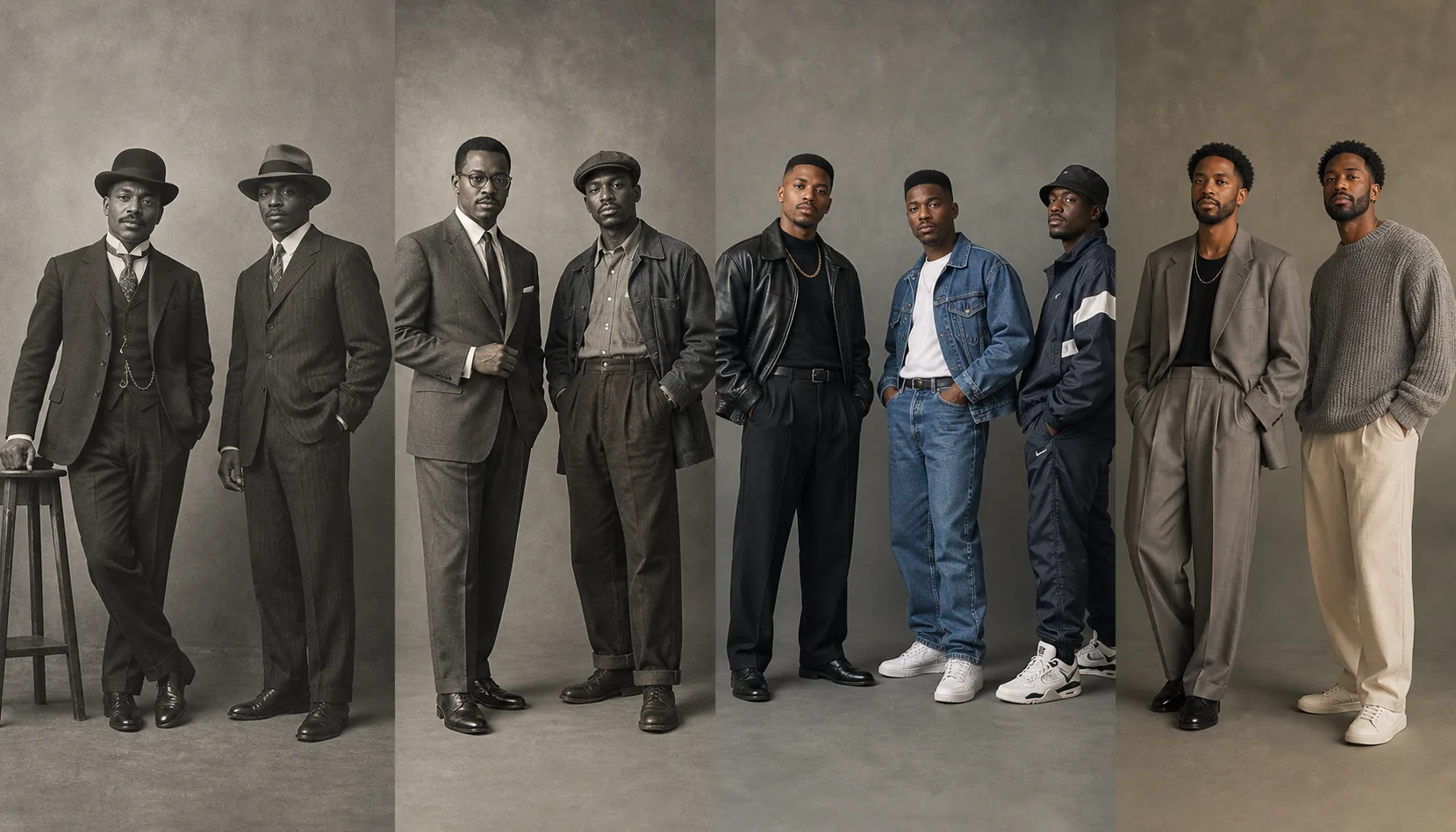
Black men's fashion changed as work, migration, segregation, civil rights, media, music, sport, retail and technology changed. Tailoring remained important across generations while workwear, athletic clothing, leather, denim and streetwear gained new meanings. No decade had one uniform: formal, practical, regional and expressive styles existed together.
Shows a specific moment, but requires date, place, creator and setting.
Construction, alteration and wear reveal use beyond brand narrative.
Adds memory and motive while requiring careful attribution.
Catalogs and ads show availability and aspiration, not necessarily daily adoption.
01 / Evidence first
A photograph is a source with boundaries
Begin with who made the image, when, where and why. A studio portrait presents a chosen self under controlled conditions. A newspaper photograph may document work, protest or public life. An advertisement constructs desire. A family snapshot can reveal everyday combination but may lack complete dates. None should represent all Black men of its era.
Read garments from outside in: silhouette, cloth, construction, condition, alterations and accessories. Then read context: occupation, occasion, region, age and class. A suit might represent Sunday worship, business, ceremony, nightlife or the only formal photograph a family commissioned. The same visual cannot be assigned one meaning without support.
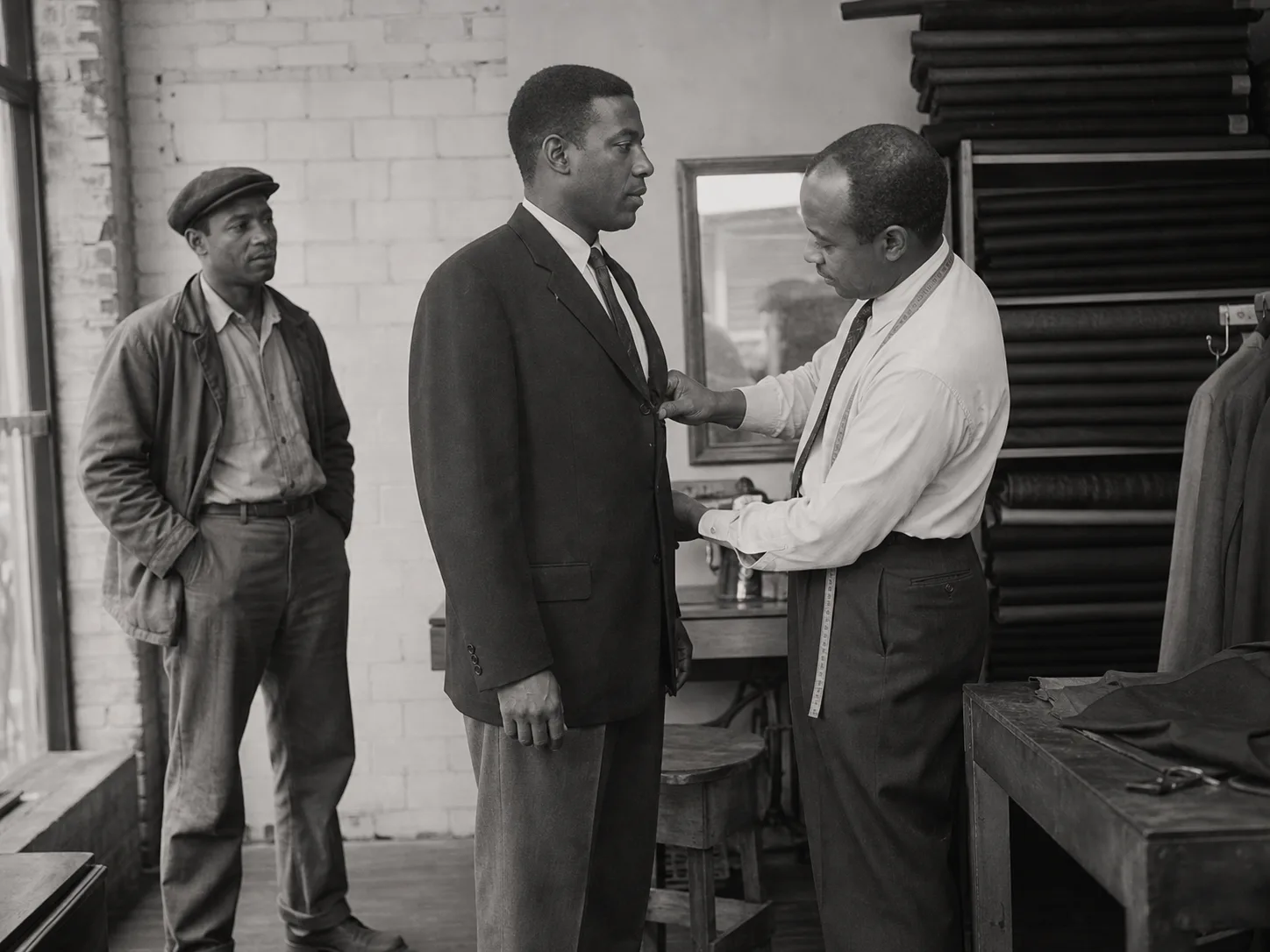
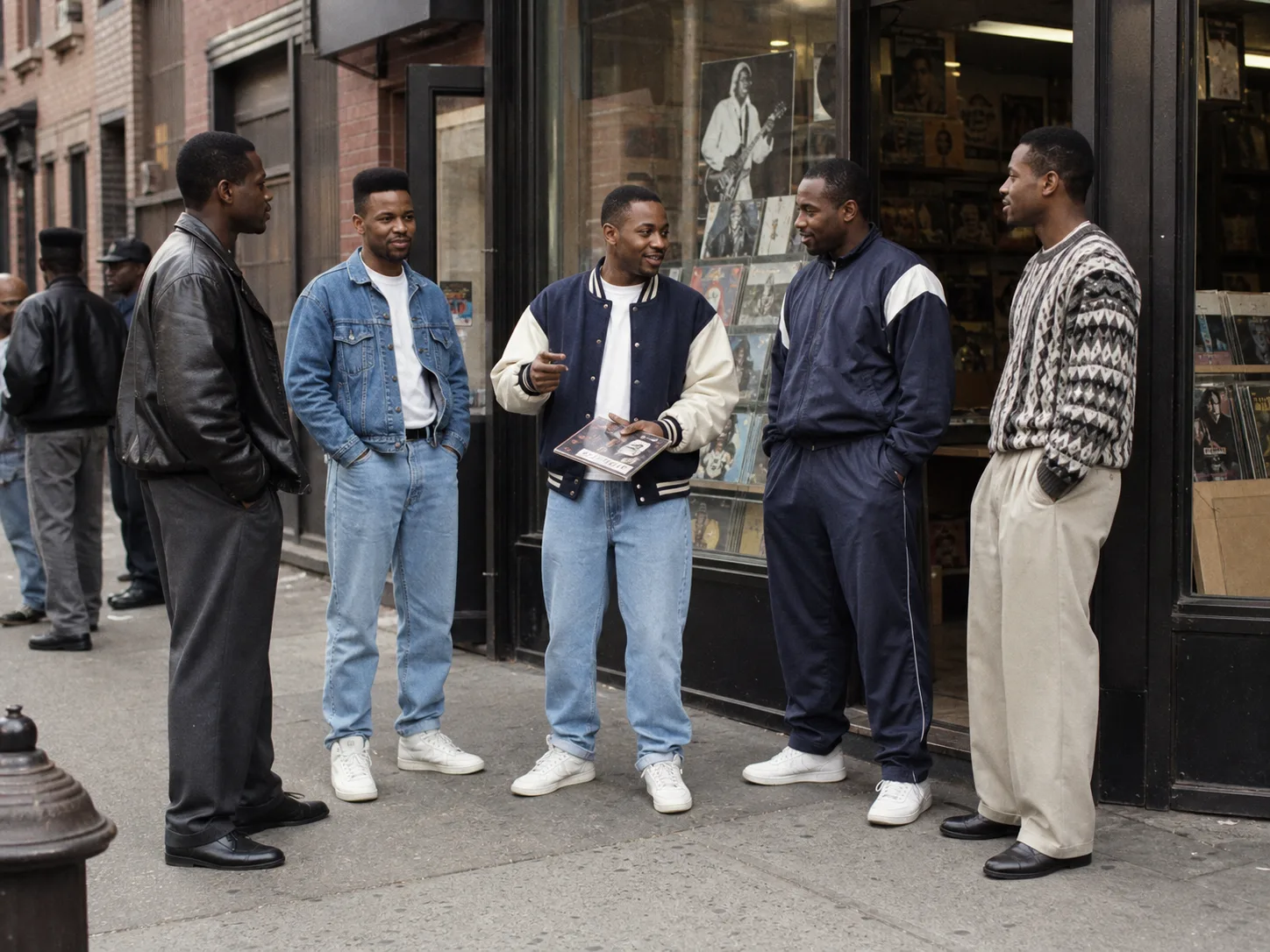
Editorial reconstructions used here illustrate relationships only. They are clearly captioned because generated scenes cannot verify historical claims. Historical conclusions should come from dated primary materials, credible scholarship and transparent sourcing.
02 / Before mid-century
Tailoring, self-presentation and imposed limits coexisted
Early twentieth-century Black men dressed across rural labor, industrial work, domestic service, entrepreneurship, professional life, church, entertainment and community institutions. Ready-to-wear expanded, while local tailors, alteration and careful maintenance shaped how garments actually fit. Hats, polished shoes and suits appear often in formal portraits, but that archive can overrepresent special presentation.
Clothing could express dignity and ambition under racial systems that judged Black appearance unfairly. It could also be practical equipment. Work shirts, overalls, boots and sturdy trousers deserve the same historical attention as a sharp three-piece suit. Separating “fashion” from labor erases much of daily dress.
Migration moved people, skills and preferences between regions. Urban retail, factory work, nightlife and new social networks changed access and silhouette. Yet regional climate and local institutions continued to produce differences that a national timeline can hide.
03 / Mid-century
Professional tailoring and everyday utility remained intertwined
Through the mid-century, suits, coats, hats and polished shoes supported church, business, civic and entertainment settings. Cut and detail shifted, but tailoring remained a language through which Black men navigated public visibility and personal taste. That visibility should not be mistaken for universal access or voluntary conformity.
Workwear continued to reflect occupation and durability. Military service, industrial labor and changing urban employment introduced garments and practical details that later moved into casual wardrobes. Sports clothing also gained presence, connecting school, recreation and public heroes.
Photographs of political organizing add another layer: clothes could communicate seriousness, solidarity, youth, cultural pride or rejection of conventional respectability. Different strategies existed simultaneously. History becomes distorted when one presentation is declared the authentic Black look.
04 / 1960s and 1970s
Natural texture, new silhouette and political meaning expanded
The decades around civil rights and Black Power brought heightened attention to natural hair, African diasporic reference, leather, knitwear, patterned shirts, wider trousers and expressive color. Some choices carried explicit politics; others traveled through music, youth culture, retail and ordinary fashion change. Visual similarity does not prove identical motive.
Tailoring changed as lapels broadened and trouser shapes moved. Casual dress gained new options, yet suits did not disappear. Soul, funk, jazz, television and nightlife amplified images that reached wider audiences. Stage clothing was designed for movement, lights and persona, so it should not be used as a direct census of street dress.
When adapting these eras now, identify the original context. A natural hairstyle, patterned garment or symbol has a history beyond its surface. Learn the source rather than using a decade label as permission to combine every recognizable sign.
05 / 1980s
Corporate image, sport, street economies and hip-hop widened the field
1980s Black men's fashion included broad business tailoring, leather outerwear, denim, knitwear, athletic sets, sneakers, hats and jewelry. Music video and television increased visual circulation, while local stores, barbershops, schools, clubs, courts and streets remained important spaces of adoption.
Hip-hop did not appear with one finished uniform. Regional scenes and different roles within music used distinct combinations. Athletic clothing could signal movement and coordination; leather could create stage authority; hats and eyewear shaped persona; sneakers connected sport, dance and neighborhood knowledge.
The 80s Black Men's Fashion guide separates professional, casual, athletic and music contexts. The 80s Hip-Hop Fashion guide narrows the lens to music culture without claiming it represented every Black man.
06 / 1990s
Relaxed volume made room for many identities
Relaxed jeans, work jackets, varsity layers, leather, tracksuits, knitwear, boots, basketball shoes and clean low-top trainers all circulated through 1990s Black men's dress. Regional climate, music scenes, retail and local preference produced meaningful differences. A coastal video image cannot automatically describe another city.
Workwear could shift from occupational utility into street styling. Basketball clothing traveled through sport and celebrity visibility. Music imagery made silhouettes memorable, but ordinary wearers, stylists, shop owners and neighborhood adoption also built their importance.
Our 90s Black Fashion pillar provides the broad cultural view, while 90s Black Men's Fashion focuses on practical garment relationships.
07 / 2000s to now
Scale, digital circulation and authorship kept changing
Early-2000s wardrobes amplified jersey length, wide denim, technical outerwear, basketball footwear, logo scale and jewelry in many visible music contexts. At the same time, preppy, tailored, skate, regional and everyday styles continued. Later shifts brought slimmer silhouettes into focus before relaxed trousers and broader tailoring returned again.
Digital media accelerated both discovery and flattening. A local style could circulate globally before its origins were explained. Mood boards separated clothes from people; algorithms repeated the most recognizable image; brand campaigns rewrote collective adoption as a single marketing story.
Contemporary Black designers, stylists, image-makers, makers and consumers work across luxury, independent labels, streetwear, tailoring and sustainability. Because people and companies change, current rankings require fresh reporting. A historical framework is stronger when it explains systems of authorship rather than declaring one permanent list.
08 / Research method
Build a timeline another reader can audit
| Source | What it can support | Main caution |
|---|---|---|
| Dated photograph | Visible clothing in one documented setting | Caption and context may be incomplete |
| Catalog or advertisement | Availability, price and marketed aspiration | Does not prove community adoption |
| Interview or oral history | Experience, motive and memory | Memory is situated and should be attributed |
| Garment or museum record | Construction, provenance and material | Collection survival is selective |
| Later brand history | Company perspective and product chronology | Marketing may simplify collective influence |
Keep the exact claim beside its source. “Appeared in a photograph” is not “invented the trend.” “Available in a catalog” is not “widely worn.” Precision makes the story more compelling because readers can see how meaning was built.
Continue the cluster
Fashion specialist guides
Evidence trail
Sources & Further Reading
These references support the historical, cultural or care-related claims in the guide. Outfit combinations and fit recommendations are BAAM Boys editorial judgment unless specifically attributed.
- The Metropolitan Museum of Art — Superfine: Tailoring Black Style
A cultural and historical examination of Black style, identity and dandyism through garments, art and photography.
- Library of Congress — African American clothing and fashion photographs
A cataloged photographic record with creator, date, subject terms, repository and rights notes.
- The Museum at FIT — Fresh, Fly, and Fabulous: Fifty Years of Hip Hop Style
Curatorial material on the invention, remixing and wider adoption of hip-hop fashion.
Research conclusion
A responsible timeline keeps parallel lives visible
Black men's fashion history cannot be reduced to a march from formal clothing to streetwear. Tailoring, uniforms, work clothes, religious dress, leisurewear, political presentation, sport and music repeatedly coexist. The historical task is to identify who wore a garment, in which setting, under what constraints and through whose surviving record.
Future revisions should add primary records and local archives before adding more trend labels. Photographs need dates, creators and context; institutional interpretations should be compared; family memories should be attributed and not generalized. When evidence remains partial, the uncertainty belongs in the published conclusion.
The timeline is therefore a research framework rather than a finished list of canonical outfits.